
National Library launches dubious display
Visitors to the National Library of Scotland are offered the chance to spot the fakes amongst the real deal in a new free display at George IV Bridge in Edinburgh.
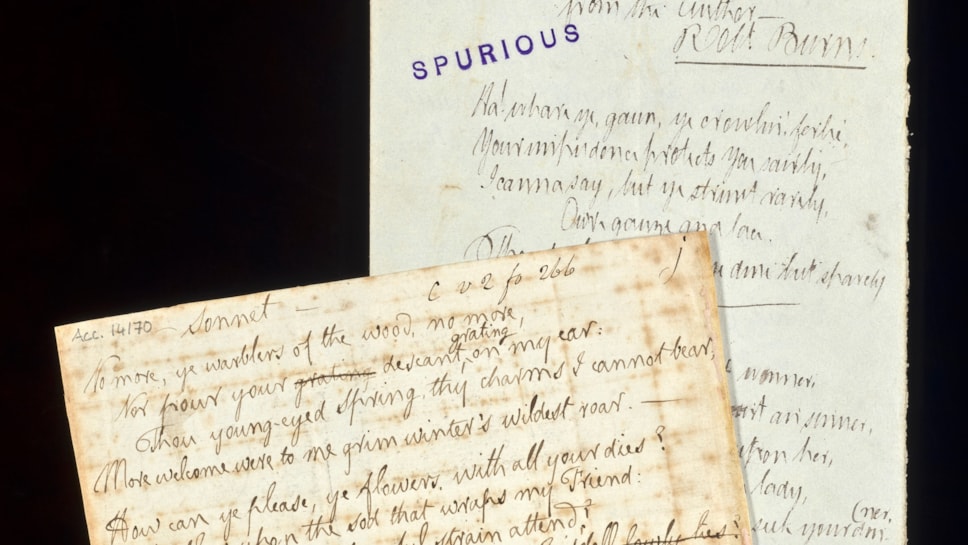
‘Fakes and Forgeries’, features a range of material from the Library’s archive collections which has historical interest because of, rather than in spite of, its inauthenticity.
The National Library’s Head of Archives and Manuscript Collections, Chris Cassells, says it’s an “opportune time” for a display such as this.
“A decade ago, ‘post-truth’ was the word of the year. Little were we to know that ten years on we would find ourselves in the era of ‘post-reality’. Deepfakes and generative AI have undermined our ability to tell fact from fake and we’re now grappling with a world where seeing is not necessarily believing. But, while the technology has changed, the history of fakes and forgeries goes back centuries.
“And many of the preoccupations that drive the creators of deepfakes today – obsessions with celebrity, power, money – are the same that drove the forgers of the 19th century.”
Forgeries of historical and literary figures such as Mary, Queen of Scots, Robert Burns, Lord Byron and Sir Walter Scott flooded the Edinburgh manuscripts market in the late 1880s. All came from the hand of one man, Alexander ‘Antique’ Smith, who went on to forge hundreds of documents by dozens of well-known figures. He was ultimately caught and sentenced to a year in jail for his crimes, However, the legacy of his forgeries is still with us and his manuscripts occasionally appear on the market where they can potentially catch out collectors.
Letters and poems in the hand of Lord Byron, who is often referred to as one of the first ‘celebrities’, were also particularly sought after in the 19th century by autograph collectors and publishers. One enterprising fraudster made it his business to meet this demand for unpublished Byronic works by producing new ones.
Known under many aliases including ‘Major Byron’ the forger claimed to be the son of Lord Byron and a Spanish aristocrat. Using this deception, he gained access to materials written in Byron’s hand and created forgeries of such quality that they even duped Byron’s own publishing house (John Murray).
Finally, the display features the Sobieski Stuart brothers, who forged both a lineage and historical documents in the mid-19th century. They falsely claimed direct descent from Bonnie Prince Charlie and fabricated a manuscript that supposedly provided detailed descriptions of tartan patterns from clans across Scotland.
Cassells adds:
“It is the practice of many institutions to actively and knowingly collect forgeries – and we are no exception. As forgers such as Antique Smith and Major Byron have become so notorious, their ‘work’ has become collectible in its own right. And like it or not, they are part of our literary history.
“The circulation of forgeries remains an issue for collecting institutions such as the National Library of Scotland. As such our curators must stay vigilant when adding literary and historical documents to our collections: to separate the fakes from the real deal.”
Fakes and Forgeries on now at the National Library of Scotland, and runs until April 2027. Entry is free.
Contact Information
Notes to editors
About the National Library of Scotland
The National Library of Scotland is the nation’s living memory – preserving the past, enriching the present, and inspiring current and future generations through access to knowledge, culture, and innovation. We chart the DNA of Scottish society by documenting, preserving and sharing precious collections that capture our past and present. We support education, promote inclusivity, empower informed citizenship, and contribute to the economic and social fabric of the nation. We strive to understand Scotland’s place in the world and to explore connections with our neighbours near and far. We reflect Scotland. Rich, diverse, unfiltered.